

Article
12 min read
Your technology didn't fail you. You probably didn't succeed in integrating it properly. Here's what happens in practice. When your organization's identity, data flows, access rights, reporting, and communication all live in separate systems, it becomes difficult or even impossible to see the full picture. This means that your staff will need to connect the missing dots by hand. Every day. It works, but not forever.
Then it hits. A missed enrollment deadline. Exam results that make no sense. An audit question nobody can answer. A security breach that goes public before anyone internally even knows it happened.
The thing is, most organisations already have the tools. There are lots of systems, platforms and licenses. The technology is there. What's missing is the layer that actually makes them work together. This layer is about governance, integration and shared logic. Without that? You don't have an integrated education management information system. You have expensive fancy software.
And here's the part that makes this urgent now: the EU's Interoperable Europe Act kicked in April 2024. Starting January 2025, interoperability assessments become mandatory. That means fragmented systems aren't just your operational headache anymore — they're becoming everyone's compliance problem. This article examines the risks that education systems face when digitalization is viewed as a list of things to buy instead of a plan through the lens of the EU's modernization framework, such as the Interoperable Europe Act (entered into force April 2024, with mandatory interoperability assessments from January 2025).
TL;DR (Key Insights):
EU’s digital education program treats digitalization as an operating-capability and governance problem (capacity, readiness, and “enabling factors”)
Over 70% of European universities report fragmented digital systems, with integration challenges outranking funding (EUA Trends 2024, surveying 489 institutions).
SIS, LMS, ERP, and CRM systems often use incompatible schemas, with integration expenses that exceed partner licenses by 2–3× over 5–7 years, yet vendors rarely warn you.
GDPR, accessibility rules, procurement discipline, and auditability requirements define what actually deploys, yet most integrations ignore them until it’s too late.
Disconnected systems create security and continuity risks, amplifying vulnerability to cyber incidents and manual error.
What is the state of 'education digitalization' in EU?
In the European Union, the focus on digital technology in education is more on creating good management strategies than on using technology.
This includes things like making sure services don't stop, protecting people's data, making sure that things are bought in the right way, making sure that services can be used by everyone, and making sure that the way the organisation works is good enough.
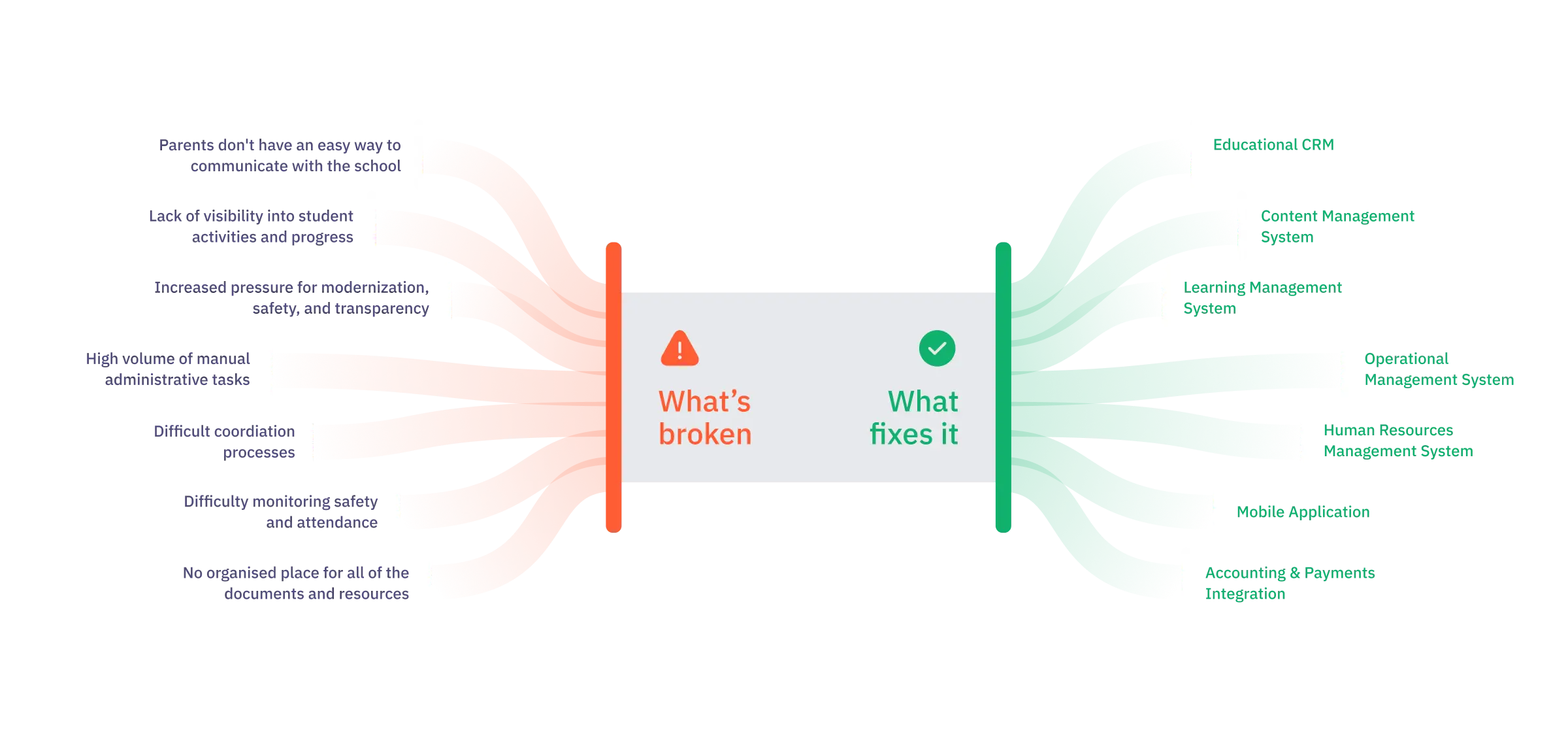 Most institutions manage these as separate units, rather than joining them together. This disjointed approach acts as an 'electrical fault,' a point where errors are most likely to occur.
In this context, the Digital Education Action Plan is focused on two key strategic priorities:
to create a high-quality digital education system, and
to improve the digital skills and abilities for everyone involved.
The EU's approach explicitly addresses structural barriers. To do this, the Commission will:
Check that the action plan is being put into action and that digital education in Europe is developing.
Share good practices by doing research, trying out new ideas, and collecting evidence.
Support different sectors working together and new ways of sharing digital learning content.
Address issues such as interoperability, quality assurance, sustainability, accessibility, and inclusion, as well as common standards.
When viewed through the lens of system governance, an education management information system (EMIS) is not merely a platform but rather an operational model that delineates the manner in which identity, data, access, and reporting functions are integrated across the institution.
Why does education need its own digital strategy?
Operating under public accountability, educational institutions manage high-risk data and seasonal spikes that require optimal performance. Digital failures are often public, leading to rapid erosion of trust and the need for prompt oversight.
Consequently, effective leadership strategies prioritize continuity and compliance over speed. The potential risks associated with disrupting an enrollment window or exam cycle are considered to outweigh the benefits of rapid modernization. Therefore, a cautious, phased transition approach is favored.
The EU acknowledges this need, allocating funds to 5G and hardware development as critical infrastructure. However, it should be noted that infrastructure alone is insufficient.
As OECD reviews consistently demonstrate, institutions frequently adopt tools more rapidly than they can integrate them. It is important to note that the implementation of new software does not automatically result in the replacement of legacy systems. Instead, the new software often adds a layer of complexity by creating redundant, parallel workloads. This can, in fact, increase complexity rather than reducing it.
What happens when education management systems are fragmented
Disconnected systems are not an exception in European education. This is the standard procedure.
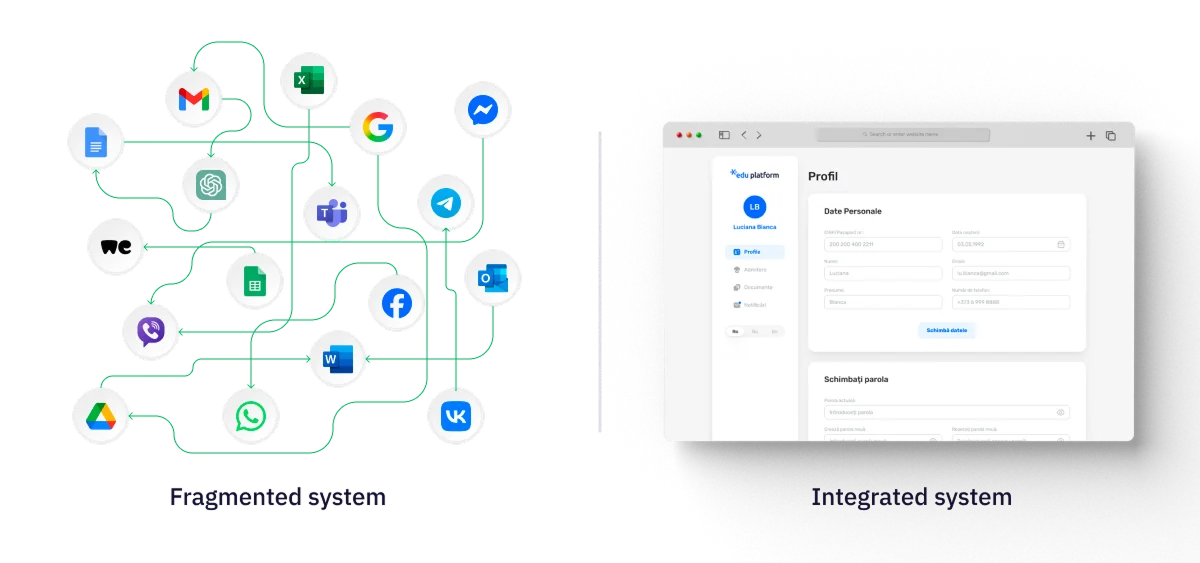
The European University Association states that over 70% of universities operate multiple digital systems that don't integrate well. Interoperability is considered a bigger challenge than funding.
It is common for schools to use different types of software, such as systems that manage student information, learning management systems, financial tools, human resources platforms, and software for education administration. However, these systems are usually not engineered to function as a unified school management information system.
If you don't integrate them, even the best student information management system won't help much. It'll just add to the other isolated databases you already have.
The digital government transformation in Moldova is a good example of this. The government has made 303 out of 648 public services digital. This is part of its "Digital Transformation Strategy 2023–2030." The government says that now more people have access to digital services (from 25% to 54%). The EVO app puts important public services for citizens and entrepreneurs into one place, and by January 2026, 75% of services for businesses were available online. Schools and other education institutions that are unsure about using this national infrastructure are missing out on major efficiency gains. Universities that work with national identity systems (MConnect) or payment platforms can get rid of paper-based administration using tools that already exist.
The World Bank's $60 million Education Quality Improvement Project (EQIP) supports approaches like this, improving education service delivery with an emphasis on digital learning environments and students who are disadvantaged — reinforcing the principle of integrating and reusing existing platforms instead of buying more separate ones.
Integrated systems improve education operations and decision-making
LMSs are changing. They are used for more than just managing learning resources. They are increasingly designed to support teaching activities such as developing and tracking assignments and assessments; managing online interactions and collaborations among teachers and students; and communicating with school administrators and parents/guardians. LMSs are starting to offer more advanced reporting and analytics, and are usually connected to the student information system (SIS).
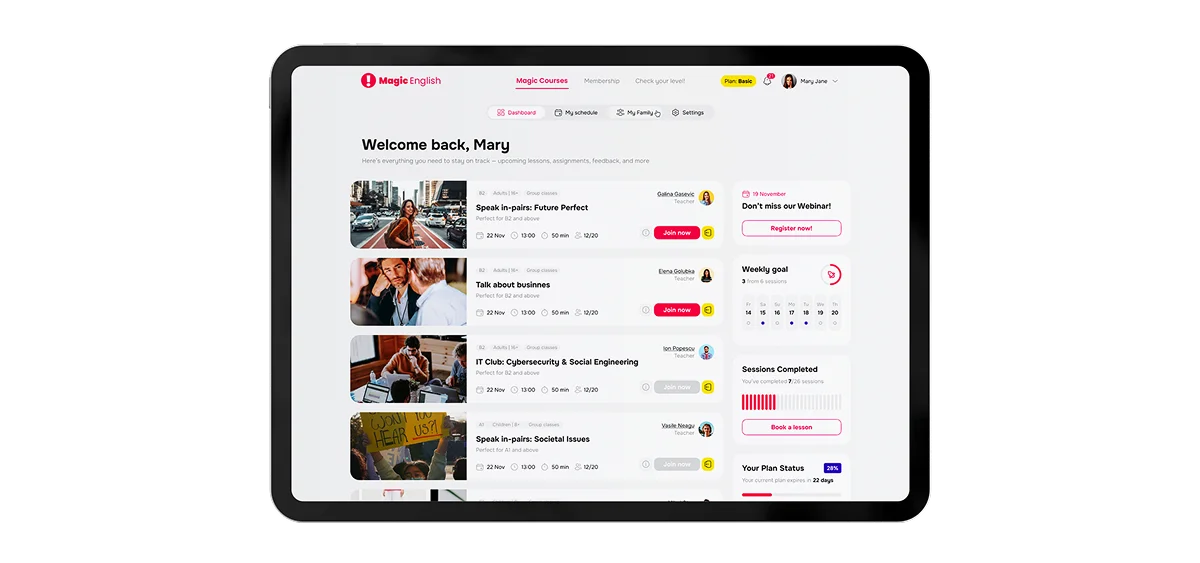 An LMS we built for an online English school (sessions, goals, and schedules integrated into one student view).
However, many institutions still run these as separate systems with different structures.
According to Gartner businesses usually have three reasons for looking for new software. The first reason is that the current software is limited in what it can do (42%). The second reason is that it is inefficient (15%). The third reason is that it is hard to use (14%).
The hidden cost isn't the license for the LMS or SIS itself, but the effort required to make these education software solutions behave like one governed system. In the long run, the costs of integrating these isolated systems can rise up to x2-3 the cost of the partner licenses. This is mostly because there's more work involved in making the data consistent and aligning identities.
Romania offers a comprehensive illustration of these costs. Given the prevalence of custom-built legacy systems at many universities, PNRR-funded modernization projects frequently encounter challenges due to the inability of new tools to communicate with existing data. The result is what is known as "integration debt," which occurs when investment in new platforms fails to deliver value because they remain isolated from operational reality.
Governance, GDPR, and education data management
Education institutions process personal data that is considered high risk.
This includes things like identity records, how well someone has done at school, how often they have been late or been late for class, any punishments they have received, and information about their family and how much money they have. Under GDPR, this data needs to be stored in a certain way, and there need to be rules about who can access it. It also needs to be kept for a specific length of time, and there need to be records of what has been done with it.
This means having good ways of managing education data, keeping it safe, and making sure it is used properly.
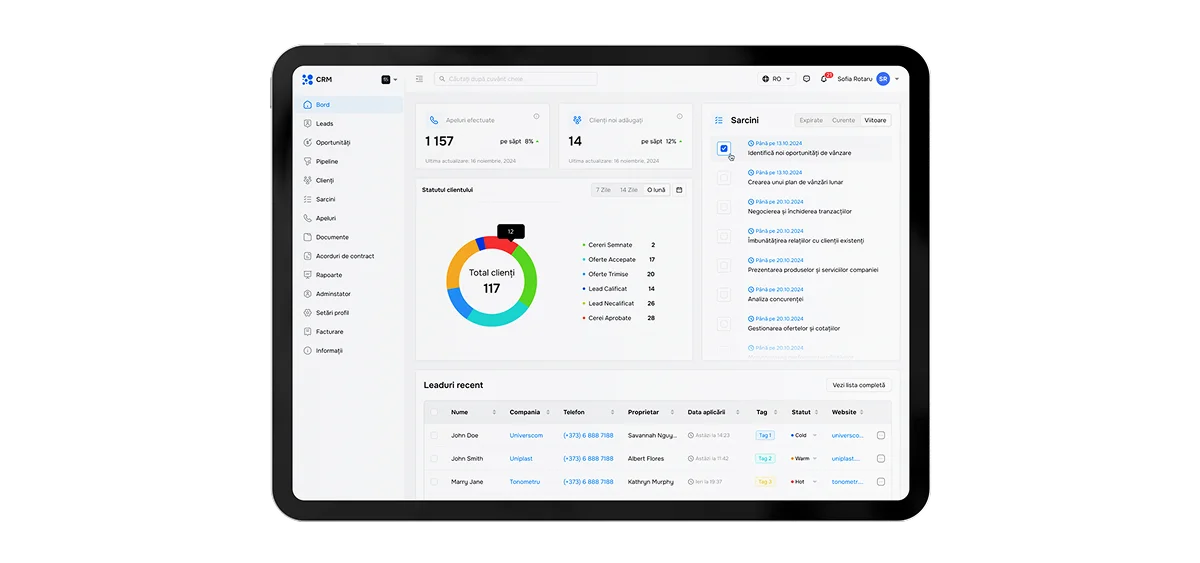 Every screen that handles personal data needs access controls, retention rules, and audit trails built in, rather than added later.
This requires strong education data management, defensible education data security, and auditable education compliance management practices.
Compliance is not an administrative step. It creates some limits to system design that must be respected from the start. To meet EU governance standards, it is necessary to have role-based access, least-privilege enforcement, traceability, and defensible data flows. Such type of phenomena make education change much slower than businesses.
Data security in education is a continuity risk
Cybersecurity amplifies these constraints.
K12 SIX has cataloged 1,331 publicly disclosed school cyber-incidents affecting US school districts since 2016. And EU security agency ENISA documented over 300 incidents impacting the sector between July 2023 and June 2024.
When systems are divided into separate parts, they create more areas for attacks because they provide unequal control over different parts of the system. Some platforms require multi-factor authentication. Others do not. Some of them generate access logs. Others cannot. Creating different controls across different platforms and not enforcing the same identity rules makes education data less secure.
Security problems can disrupt important operations, such as exams, enrollment, certification, and communication. Attackers find the weakest links and exploit them. Schools can't stop operating while they replace IT systems, so they are replaced in stages. If you don't have governance oversight, staged approaches make things more complicated instead of making them easier.
A review of the risks at the Union level showed a significant cyber threat level for the EU. This review also showed weaknesses that hackers could use to attack EU entities. Modernization only reduces risk when security is included from the start. Otherwise, digital expansion increases exposure.
Accessibility, auditability, and administrative load in education systems
All people, including those with disabilities, language barriers, or poor internet connection, must be able to have access to EU’s digital services. The criteria for choosing suppliers often include:
WCAG 2.1 compliance
System-wide inclusion mechanisms
Clear documentation for audits
Projects that receive funding from the EU Recovery and Resilience Facility (RRF) often report that rules about compliance, audit documentation, and procurement can account for up to 80% of the operational costs.
If your systems are not integrated, it's hard to keep track of what happened, which makes it difficult to comply with regulations.
Standardization vs autonomy in education software ecosystems
European education systems vary greatly. Digital maturity levels differ significantly among institutions, regions, and governance frameworks.
Standardization makes security and interoperability better, allowing for easy data exchange and fewer vulnerabilities. But it can also limit how much local groups can make their own decisions, which can make it hard for institutions to provide the right solutions for each unique situation. On the other hand, having separate or divided systems keeps things separate but also increases the risk of problems like data that doesn't flow smoothly and more chances for errors or security breaches.
This tension often leads to "vendor accumulation," where organizations collect a variety of suppliers without having a plan to integrate them.
For example, Learning Management System (LMS) features are often not used as much as they could be at schools, even at the most technologically advanced schools. This is usually because there is not enough training or because what the vendor offers and what the school needs are not a good fit.
This problem is made worse by the fact that companies often choose to use "point solutions" on their own, without checking if they work well with the systems they already have. Each new tool has its own costs, like training, checking compliance, and ongoing support. These costs add up over time and cause problems that make IT more fragmented and expensive.
AI in education: risk, ethics, and operating discipline
The potential of artificial intelligence (AI) to transform education is significant, with applications ranging from personalization of learning to automation of administrative processes. However, it also poses substantial risks to institutional reputation, operational integrity, and stakeholder trust.
Deloitte's research shows that the use of AI in education is slowing because people are concerned about its ethics and regulations. The main concerns are that the reasons for decisions made by algorithms are unclear, that data might be shared without people's knowledge, and that users disapprove of the way data is used.
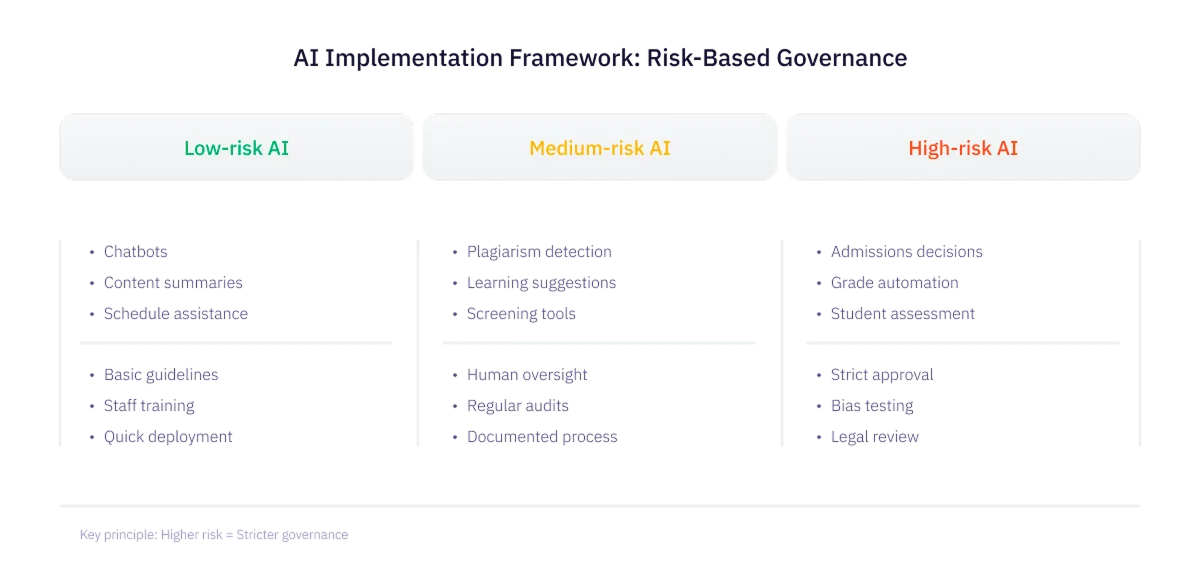 Higher-risk AI decisions in education demand stricter governance — from basic guidelines to legal review.
Without proper content governance, learning content management can become disorganized. It can spread across shared drives, chat apps, and personal accounts, with no central oversight. This can reduce efficiency and expose private data.
It is important to have clear governance policies. AI can make workflows better or worse, depending on how it's used. There are different rules for low-risk information compared to high-risk things like student assessments or automated decisions about who gets into university. These need different protections to stop bias, privacy problems, and problems with accountability.
Conclusion
If we perceive digital education as a technology issue alone, we'll get more platforms but not less workload.
Instead, treat it as a problem with how the organization is governed and how it operates. This makes things more consistent, improves data reliability, and makes the organization stronger when it is audited, under a lot of pressure, or under public scrutiny.
Studies on EU policy, institutional reporting, and sector research consistently show that integration and governance are more important than the choice of specific tools.
Modernization only works when governance leads. Without it, complexity becomes permanent. Modernization based on governance brings together these different tools to create a strong education software infrastructure, instead of creating a complicated system of platforms.
Frequently asked questions
What is an education management system?
An education management system is a set of digital tools and rules that are used to manage things like identity, data, access rights, workflows, and reporting across an institution. Its value comes from how well it is integrated and how disciplined the operation is, not from the number of platforms used.
Why do education digitalization projects fail?
Most fail because tools are deployed without aligning data, identity, access, and responsibility. Fragmentation persists, manual work increases, and visibility declines.
Why is integration more important than software choice?
Because integration determines whether systems share trusted data, enforce consistent access, and support audits. Without integration, even good tools create parallel workflows.
How should institutions choose education software solutions?
Organisations should check if a solution improves governance, how well it can work with other systems, and if it complies with regulations — not just what it can do. Architecture matters more than functionality lists.
Share this article on:
More insights
Events
News
Digital Transformation
In today’s rapidly evolving business landscape, #digitaltransformation goes beyond the mere implementation of technology. It represents a fundamental change in the way organizations operate, deliver value, and interact with their stakeholders. This transformation isn’t just about adopting new technologies; it’s about fostering a culture that embraces change, overcomes legacy standards, and is adaptable to change and error.
12 Sep 2023
IT Consulting
Software Development
Agile Project Management
The digital age is an exciting time for businesses, as new opportunities abound and technology advances quickly. However, it also poses the age-old question: how do we stay ahead of the competition while navigating this ever-evolving digital landscape? At EBS Integrator, we’ve found the answer to this conundrum lies in optimizing work processes and delivering top-notch IT solutions and products. In this article, we’ll reflect on the importance of these processes and explore how partnering with EBS Integrator can benefit your business.
11 May 2023

Article
Data engineering
IT Consulting
8 min read
We’re talking about data privacy in all its glory – why it matters to you and your customers, and where it’s all heading in the future. Because this is a part of a series, we’ll try and focus mostly on the aspects that affect us in the eCommerce domain! Let’s discuss why there’s so much hubbub around the topic of data privacy. This is not to say this discussion is anything new for the world, it’s been brought up countless of times, and the issue of “government spying” on you is as old as the idea of structured government is.
18 Feb 2022

Article
Digital Transformation
10 min read
Companies involved in the movement of goods and the management of logistics are undergoing major changes to keep up with the demands of today's customers and the rapid pace of change in the marketplace. What they're doing is making extensive use of digital technologies - that is, using computers, the Internet and other digital tools not just to improve the way they work, but to fundamentally change the way they operate, interact with customers and run their businesses.
18 Mar 2024

Article
Digital Transformation
Technology
6 min read
EBS Integrator evolved naturally, driven by a deeper impulse to adapt and grow. CEO Vitalie Aremescu founded the company in response to this fundamental sense of evolution. "I realised that I needed to evolve," Aremescu shares in an interview with Wall-Street.ro. Today, that same impulse continues to run a company that not only provides technology expertise, but also teaches others the importance of evolving in an ever-changing environment.
30 Sep 2024

Article
Mobile App Development
Digital Transformation
8 min read
See how mobile apps can boost your business growth. Some remain unaware or have tried without success, but our tech leads in iOS & Flutter prove that modern app development truly works.
23 Oct 2024

Article
DevOps
IT Consulting
9 min read
Data storage has evolved from paper/floppy disks to cloud tech. See through our experts' experience what cloud migration is, how can you use it for your business and what you get from migrating your data to the cloud.
08 Nov 2024

Article
IT Consulting
7 min read
Learn about personalized customer experiences, data-driven decision-making, omnichannel approaches, AI/AR and real stories of how we help businesses implement new business models.
22 Nov 2024