

Article
15 min read
Imagine trying to manage the enrollment of thousands of students across four different platforms, each with its own unique data fields. Now imagine doing that with a team that uses 70% of its time to maintain legacy systems. Then add to that an AI compliance mandate, a cybersecurity target on your back, and a vendor pitching you tool number 31. This is Tuesday at a university in Europe. This is what the data actually says:
TL;DR (Key Insights):
Legacy administrative platforms across European education institutions were procured separately with no shared architecture, creating education data silos that force daily manual reconciliation — while 70% of IT capacity is consumed maintaining these systems.
There is a lack of professionals with the necessary skills and experience to develop integrations at scale. ICT specialist numbers range from 8.6% in Sweden to 2.5% in Greece. The EU is 9.7 million ICT specialists short of its 2030 target.
AI in education surged from 66% to 92% in one year, causing an imbalance in an ecosystem that was already overloaded. Market projections estimate a growth from $5.3 billion to $88.2 billion by 2033.
The EU AI Act classifies education AI as high-risk and requires phased implementation from 2026-2027. The Data Protection Act mandates data portability by September 2025. Institutions face increasing cybersecurity risk due to outdated, disconnected infrastructure. EU funding programs allocate significant funds to digital skills and interoperability, but often these funds don't reach the intended middleware, integration engineers, and institutions in time.
In 2025, two public educational institutions closed for the first time. Deloitte calls this "systemness," the coordination of components that no individual institution can achieve alone.
What the day looks like when nothing integrates
No shared systems, no shared architecture
Legacy administrative platforms were procured at different times, by different departments, with no shared data architecture, creating education data silos that cannot interoperate.
McKinsey research updated through June 2025 confirms the result: higher education software "were not built to interoperate, and businesses have needed to write a large amount of custom code to make these systems communicate." In higher education specifically, a senior practitioner stated it in May 2025: "When systems speak different languages and data lives in silos, digital transformation stalls."
By October 2025, progress remained slow. "Unified data infrastructure, effective governance, a strategy aligned to institutional goals, and a culture that supports data-driven decisions in education" were still being presented as future requirements.
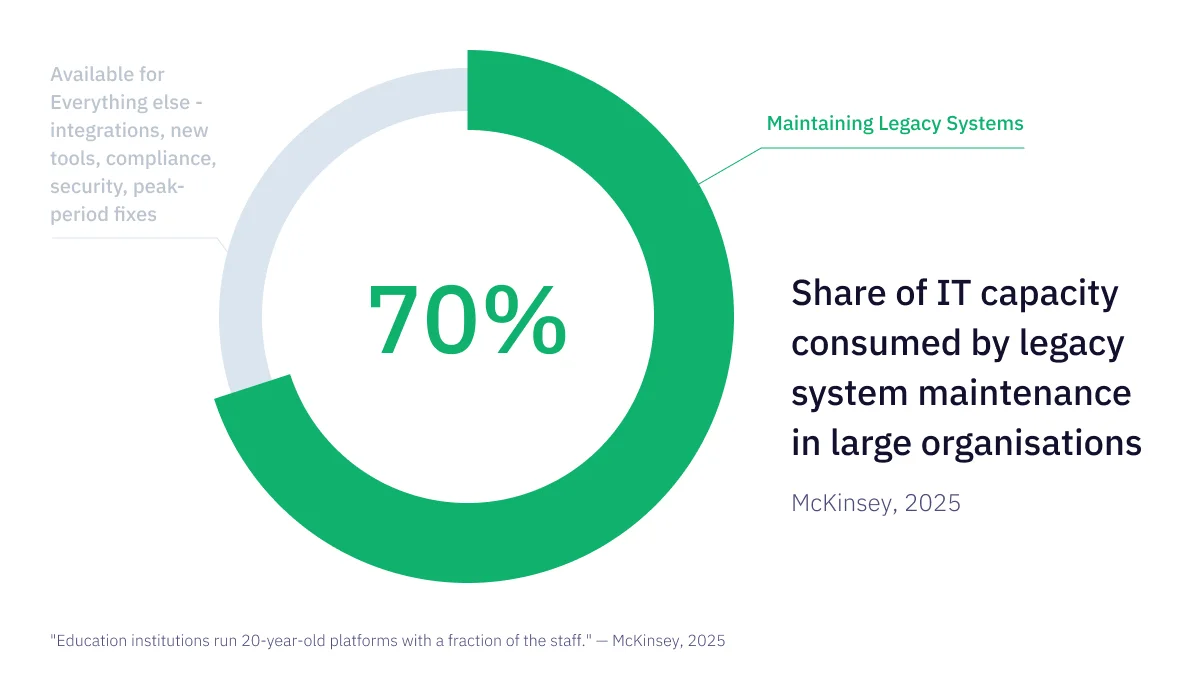
McKinsey's analysis explains why progress is blocked: 70% of the IT capacity is spent maintaining legacy systems, and much of the software used by Fortune 500 companies was developed 20+ years ago. Educational institutions now run on older platforms and have fewer staff to maintain them.
Who's available to do this work
There are two problems. One problem is that the infrastructure is old and broken. The second problem is that there are not enough people to fix the infrastructure.
Eurostat's SDG 4 monitoring states that many people still don't have basic digital skills, work in places that are behind in digital technology, or can't access digital tools and networks. The State of the Digital Decade 2025 report shows how this is happening.
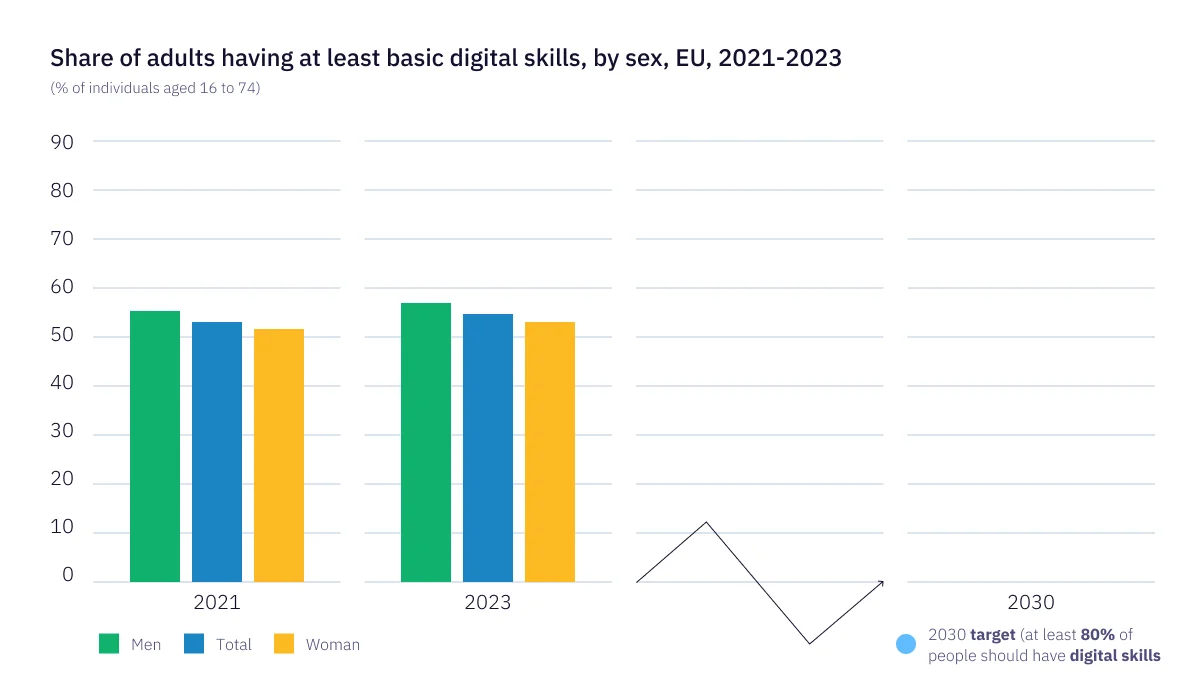 In 2025, 60% of the EU population aged 16-74 had at least basic digital skills. This is 20 percentage points below the 80% target for 2030.
There is a big difference between countries: the Netherlands at 84%, Romania at 32%. This is a 52-percentage-point difference within the same group of countries. People with leadership roles in countries with low scores hire from this group.
September hits. The scripts stop working.
The hours when custom scripts stop holding
Since 70% is spent on maintenance, there is not much remaining for adding extra capacity. These systems are very busy during enrollment weeks, exam registration, and term starts. Custom scripts can't be scaled. Staff have to deal with long lines of people, and there's no way to organize them or automate the process of fixing them.
Now, outside pressure is making things even more difficult.
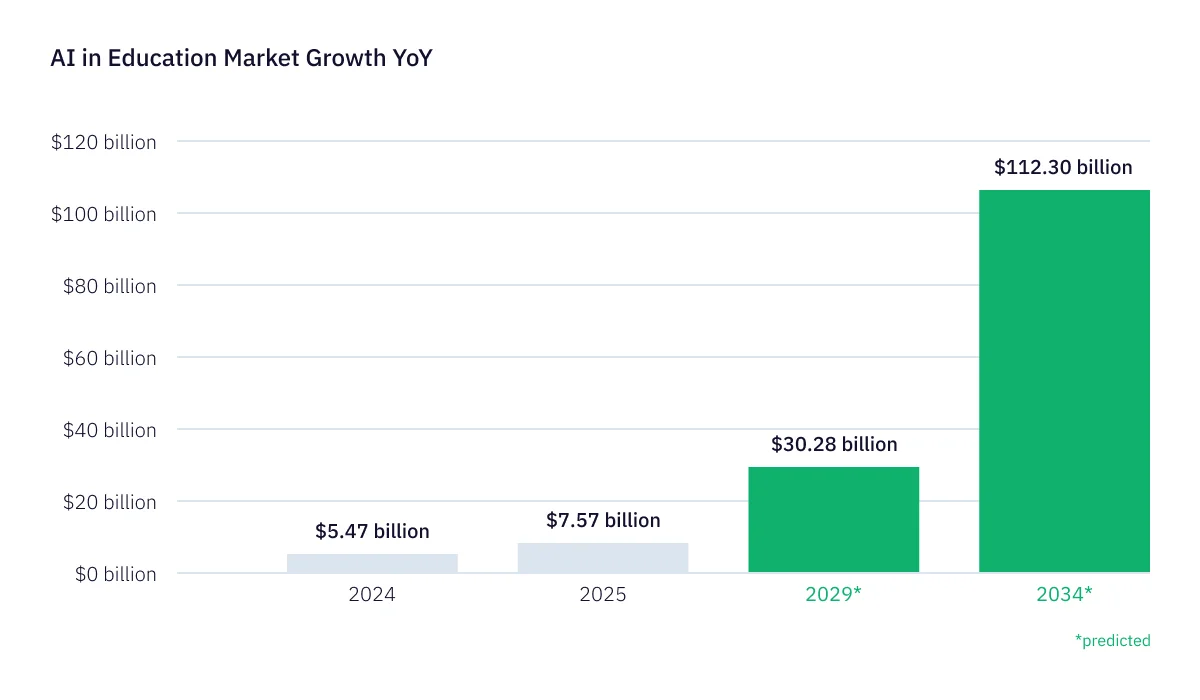 Student AI usage jumped from 66% in 2024 to 92% in 2025, with 88% using generative AI for assessments — up from 53% the year before. This big change happened in just one school year. It created a need for policies and infrastructure that administrative systems were never designed to support.
Every new tool is a new silo
Vendors are making things more complicated. One major vendor introduced more than 30 new AI tools for education at the ISTE conference in June 2025. At the same time, the vendor admitted that "educators are already having a hard time adapting." Many other companies are making new tools, and one of them says that 2.5 million teachers use their products. Vendor pitches refer to research showing that teachers work 50 hours per week. This means that AI could save teachers 13 hours per week.
The money flowing into the country shows this. The AI in education market was valued at $5.3 billion in 2024 and is projected to reach $88.2 billion by 2033—a compound annual growth rate (CAGR) of 36.8%. Investment in EdTech reached $2.6 billion in 2025 alone. But when systems are used without being planned together, it's easy to see what will happen: new data groups that can't talk to each other, and growing pressure on teams that are already expected to use many different platforms that don't work together.
Can't hire. Can't train. Can't integrate.
ICT specialists, skills shortages, and training that never reaches staff
Eurostat's July 2025 data shows that more than 10 million ICT specialists were working in the EU in 2024.
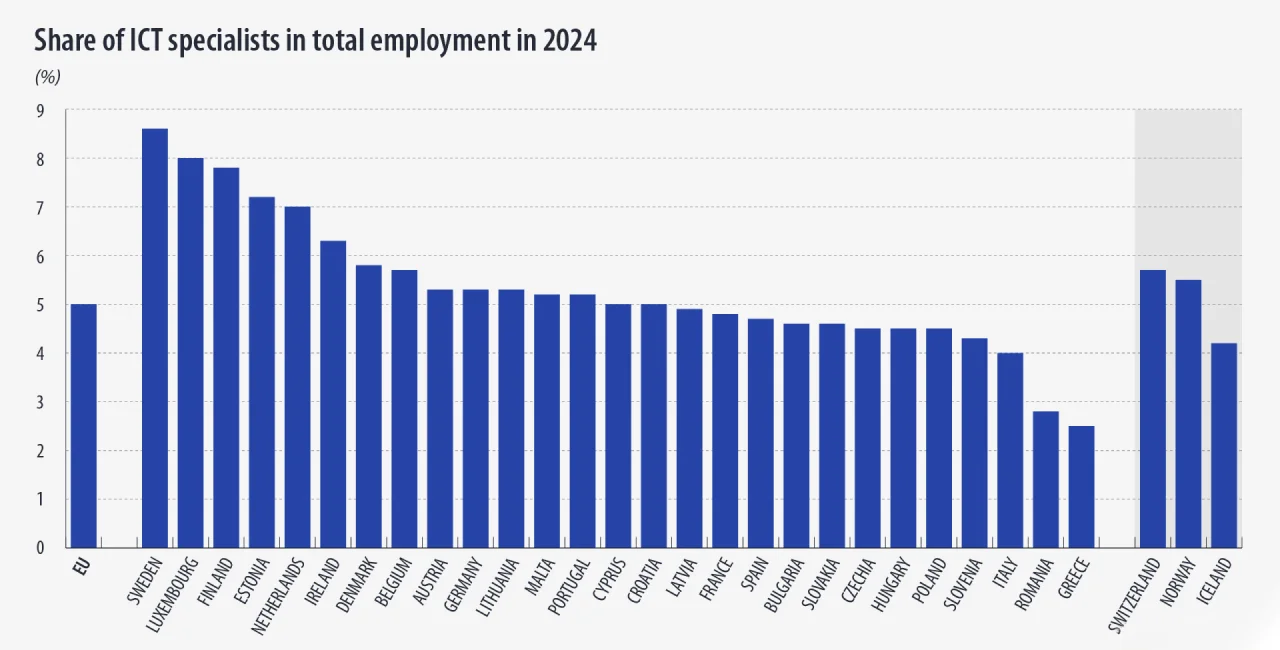 This group made up 5.0% of all people working in the EU. The distribution is very uneven. Sweden at 8.6%, Greece at 2.5%, and Romania at 2.8%. The difference between Sweden and Romania is the key to whether an institution can keep the custom code that connects its administrative systems.
The European Commission's 2025 Single Market report shows this. "There aren't enough skilled workers to use digital technologies." The gaps are there for a reason. Adult training participation is at 39.5%. The EU is 24 percentage points short of its digital skills target, 9.7 million ICT specialists short of the 2030 goal, and 17 percentage points behind on SME digital intensity.
Within countries, disparities are equally severe. Digital skills range from 82% among highly educated populations to 38% among those with low or no formal education. Within-country gaps reach 67 percentage points in Croatia, 63 in Portugal, and 62 in Malta. In Central and Eastern Europe, 64% of CEOs say that skills shortages are "very" or "extremely" affecting their businesses, which is higher than the global average of 52%. Almost half of the people in charge of helping employees learn new skills think there is a "skills crisis."
Even when training is provided, it doesn't reach the people who need it most. 76% of leaders believe that AI training has been provided, but 45% of educators worldwide and 52% of US students say they haven't received any. Meanwhile, most of the company's IT capacity is used for maintenance. The people who can build integrations are keeping old systems alive.
Where the money goes, and where it doesn't
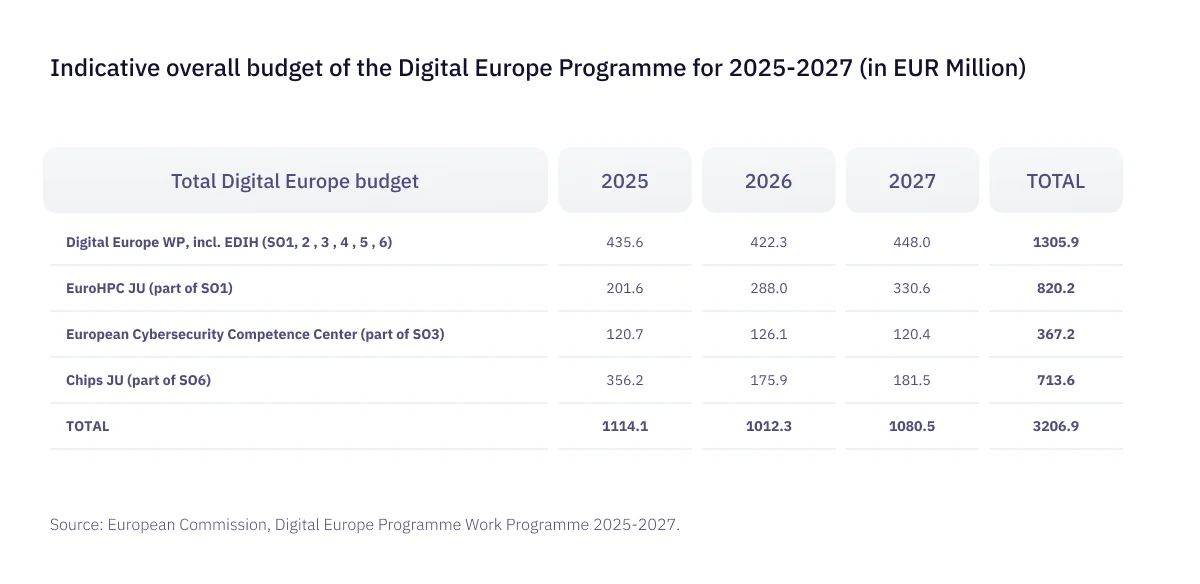
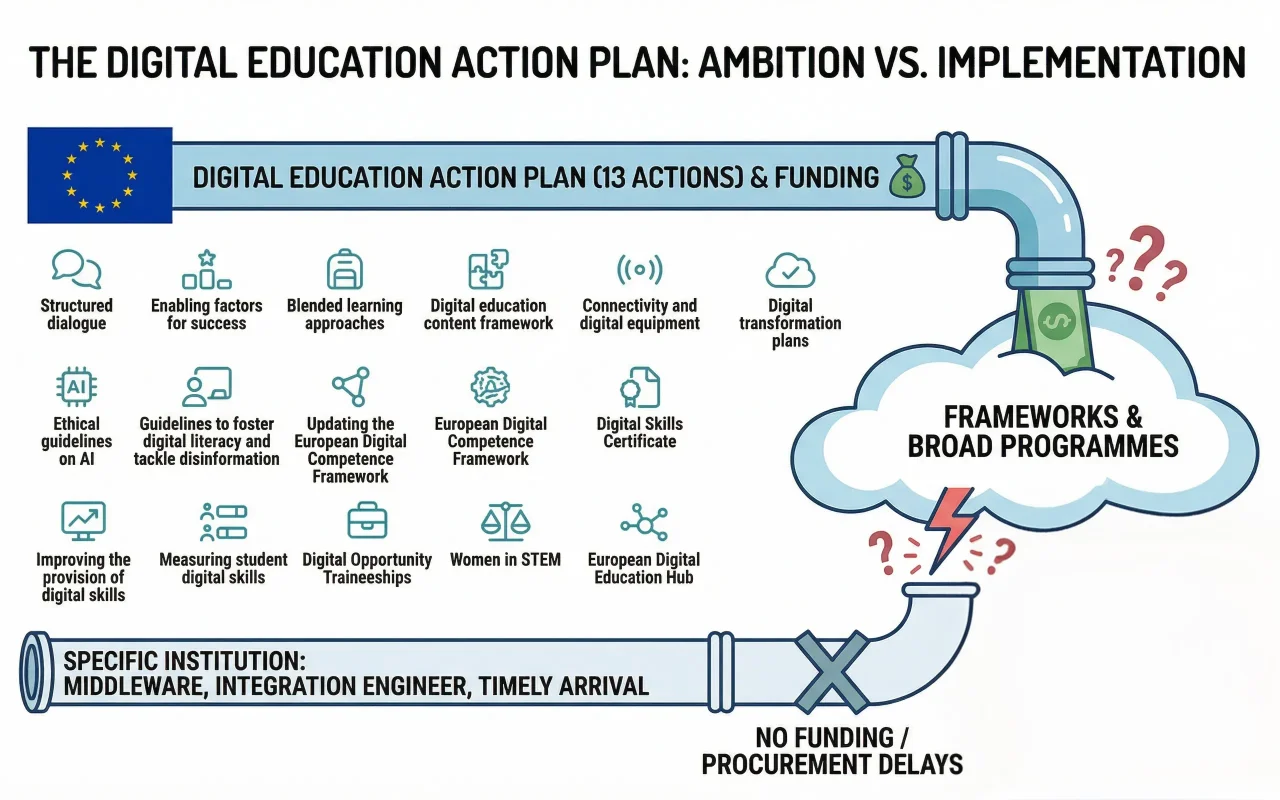
There is money available. The Digital Europe Program is spending over €400 million on advanced digital skills and solutions that work across borders. European Union countries set aside 26% of their recovery and resilience funds for digital transformation, which is more than the 20% minimum. The Digital Education Action Plan has 13 actions. DESI has shown ongoing problems despite years of effort.
 But the money goes to frameworks and broad programs. It doesn't reach the middleware in a specific institution. It does not pay for the integration engineer. And procurement rules mean it doesn't arrive when there's a bottleneck.
 People all over the country can see this gap. Estonia spends more than 6% of its GDP on education. While at the same time, the Romania's digital public services are about 20% below the EU average.
Compliance, cybersecurity, and the regulatory load
"Wealth of data, outdated systems" — a hacker's dream
Disconnected systems create active security risks, which is a major trend in cybersecurity for higher education. Schools have faced a surge in cyberattacks since the pandemic, as attackers target their large amount of data and often outdated systems. People in charge of a district hire crisis PR firms to hide news about a breach. The same infrastructure that slows operations also makes institutions easy targets.
Hallucinations, cheating, and the Data Act
The number of rules is increasing in many areas. The EU AI Act says that education AI is high-risk. It has requirements for managing risk, data governance, and transparency. These requirements will be phased in from 2026 to 2027. The Digital Services Act set general rules in February 2024 and strengthened child protection measures in 2025. Starting in September 2025, the Data Act will require data portability, including education data.
The rules are becoming more and more confusing. The US FTC warned American tech companies not to use EU DSA and GDPR rules in ways that could confuse global EdTech providers.
The tools themselves resist governance. A survey of Harvard students found that they use AI for both learning and cheating. Studies show that AI might make it harder to think critically. Hallucinations are "an inevitable part of how large language models work." These are the risks of AI in education that operations teams take on, in addition to their daily manual tasks.
From Brussels frameworks to Moldovan classrooms
The data from different regions shows both the problems and the clear solutions. In December 2025, Moldova did its first national digital competence test. The test was an important starting point. 3,021 students in grades 9 and 12 took the test. 64% of the students showed they had intermediate to advanced digital skills. This is a good foundation to build upon. But 810 students at the intermediate level, 210 at the elementary level, and 77 at no recognized level need more targeted support.
Moldova's education management information system (EMIS) has been successful in general and vocational education, and plans are now in place for higher education. Deputy Secretary General Ludmila Pavlov confirmed that the country's plans align with Europe's. This shows that the country is committed to following European standards as it begins to put its higher education management system into action.
Romania, on the other hand, is working to catch up to the EU average by investing in digital public services. Right now, Romania is about 20% below the EU average.
Someone actually built the thing
The response has been quick and more coordinated. In 2024, Moldova started a program to teach people how to use computers and the internet. In May 2025, the e-Governance Agency said that digital education is a "continuing priority."
But digitizing the classroom is only half the battle. The way schools are run must also change at the same speed. The E-Admission System, created by our team, is a key part of this system update.
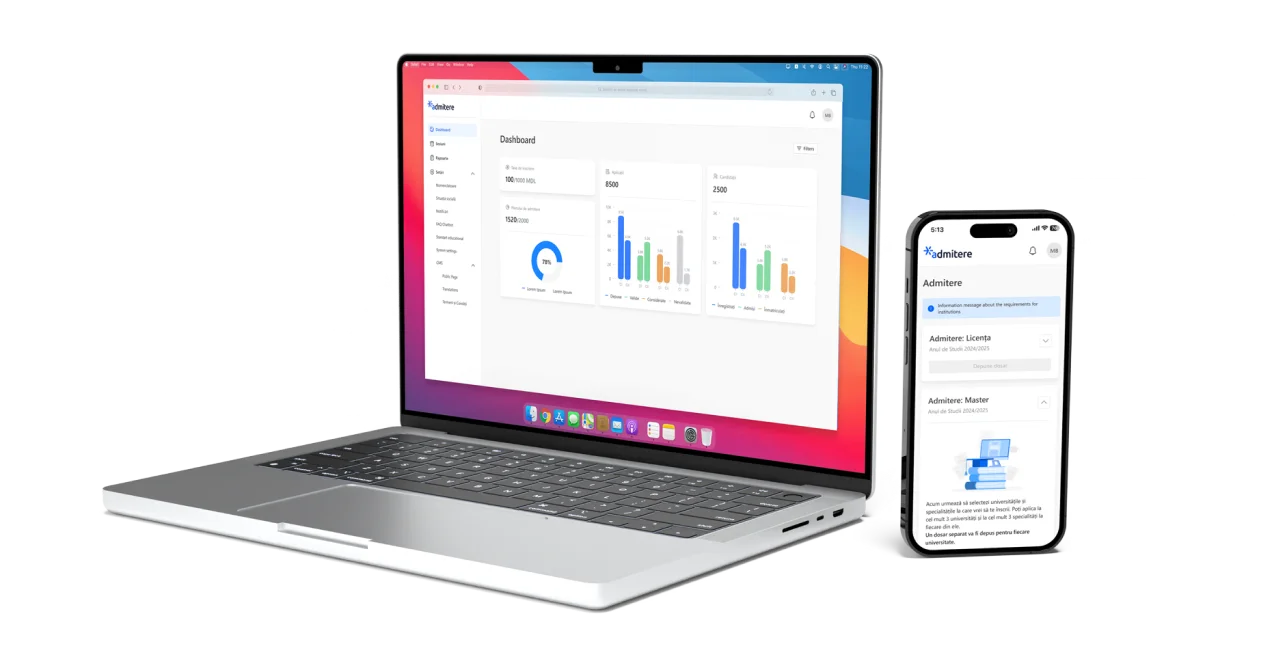 This platform makes the university and college application process easier for thousands of students. It is the main way that students can apply to college online. It removes the physical barriers and bureaucratic obstacles that were once part of the Moldovan admissions process, providing the reliable, high-capacity infrastructure needed for a nation to improve its academic standards.
This change towards structural automation is the foundation for new ideas to grow. A recent TechLab event brought together 32 IT teachers to discuss ways to improve skills, and students have started showing the difference in technology at high-level competitions. Two students from Moldova won first place at the 2025 Intel AI Global Impact Festival. They won for their creation, EDU-RAG. EDU-RAG is an offline AI tutor.
Signs from across the border and from the market show that this progress is continuing. The EU is funding a project called BiblioTech. This project will use technology to make digital copies of over 1 million pages of school textbooks. The budget for the project is more than €750,000. Moldova's exports of educational services doubled in five years as the country started to follow European standards. In Romania, one EdTech company reported a 4-fold revenue growth in the first half of 2025, reaching a profit of 5.4 million lei. The market is growing because there are real opportunities. These opportunities are made possible by a combination of large-scale infrastructure, such as the E-Admission system, and local AI tools.
This is now an existential question for education
"Systemness"
Deloitte's December 2025 report introduced an important idea: "Systemness is when different parts work together to create a network of activity that is more powerful than any one part on its own." The stakes are no longer hypothetical. In 2025, two public two-year schools closed for the first time ever.
62% want digitalisation. 45% worry about skills. 70% want EU action.
There are a lot of things happening at once. Most of the IT capacity is locked in maintenance. Breach suppression has become routine. In February 2026, the President of the European Commission wrote a letter. In the letter, he said that education that is not connected makes it hard for countries to compete. The Digital Decade report says that there's a need for "renewed action." Currently, 60% of the skills are at 60%, but the goal is 80%.
People's opinions show the tension.
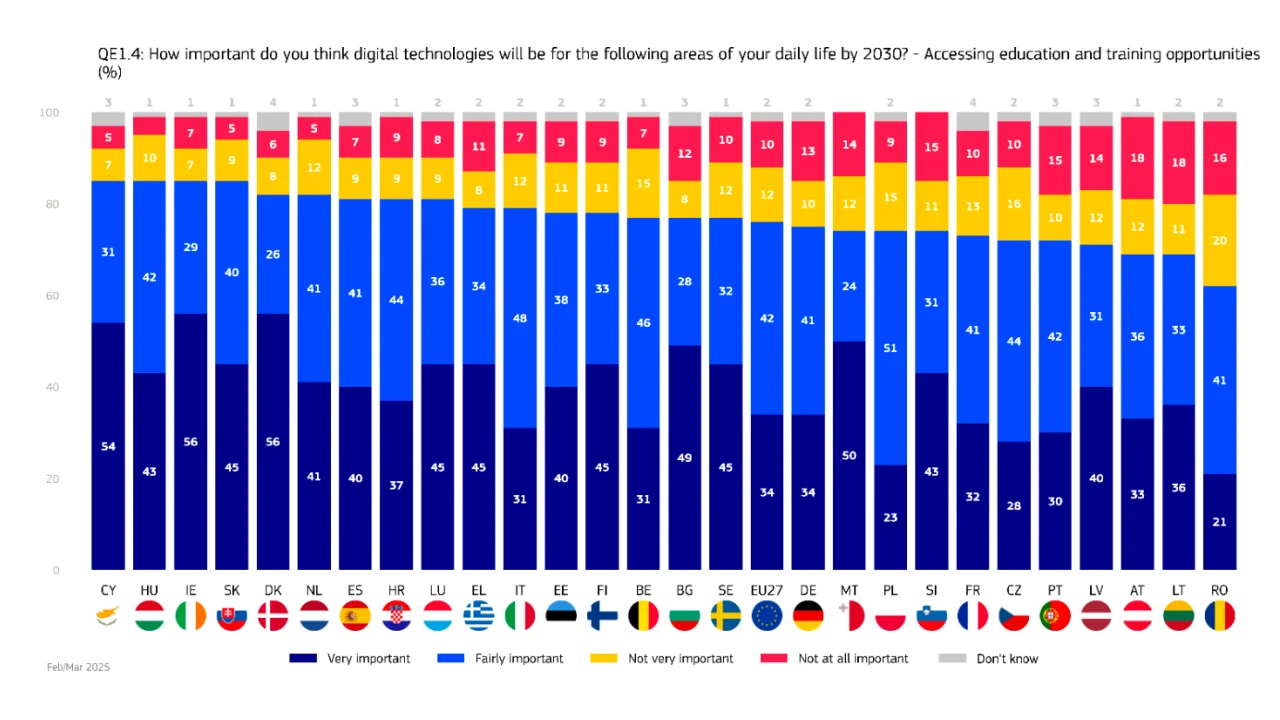 The 2025 Eurobarometer shows that 62% of people have a positive view of digitalization for education, but 45% are worried about skills gaps. 70% of people support action by the EU. The mandate exists. The capacity does not.
Educators themselves have different opinions. In October 2025, officials talked about using AI in education at the White House. However, different institutions are ready for this in different ways. In July 2025, several hundred educators signed an open letter: "We have to stop the use of tools that are not made by educators."
People like registrars, COOs, admissions directors, and IT operations managers are in a position where all of these forces meet. They can't fix the old computer systems, hire the best employees, speed up buying processes, or stop the flood of new rules.
The question is no longer whether schools will update their administrative systems. It's about which ones will do it before the gap becomes too big to overcome.
Frequently asked questions
What is a data silo?
A data silo is a system that is isolated from other platforms. Information such as student records, admissions, and scheduling is unable to communicate with other systems due to the silo's design. As a result, manual data reconciliation and costly, fragile custom coding workarounds are required, which block the unified infrastructure modern institutions require.
What are the cons of AI in education?
Most fail because tools are deployed without aligning data, identity, access, and responsibility. Fragmentation persists, manual work increases, and visibility declines.
Why is cybersecurity critical in education?
Educational institutions are prime targets because they hold extensive sensitive data while running outdated, disconnected systems. Post-pandemic, cyberattacks have escalated, causing some institutions to hire crisis PR firms. Data breaches threaten student data, operations, and institutional credibility.
What is data-driven decision-making in education?
True data-driven decision-making requires a unified infrastructure that eliminates delays in manual reporting. Without integrated systems connecting admissions to outcomes, institutions base decisions on approximate, delayed data instead of real-time intelligence. Current fragmentation means that this remains an aspiration rather than an operational reality.
Share this article on: